

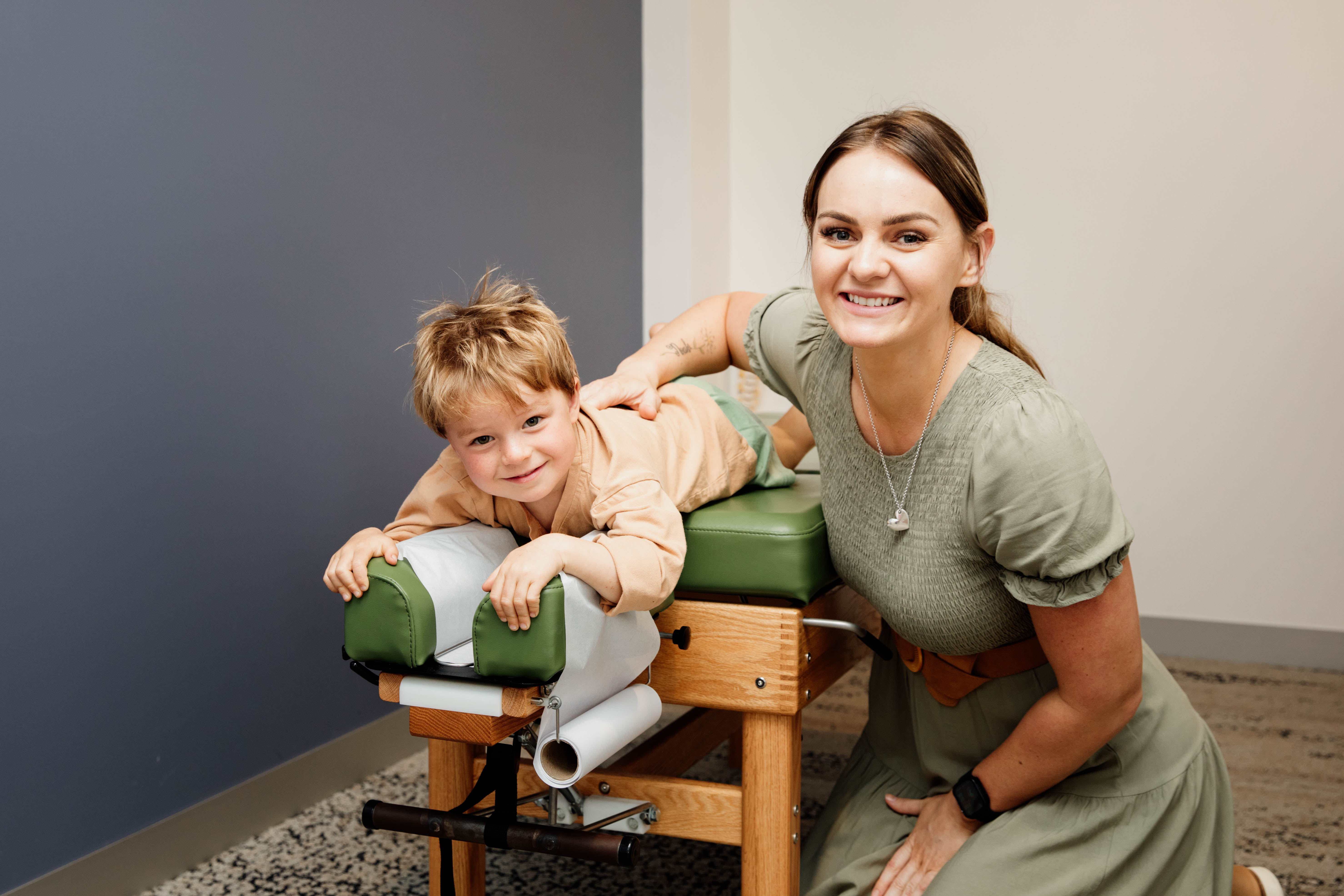
Children's bodies are constantly growing, moving, and learning. From a baby lifting their head for the first time to a toddler finding their balance, every new movement is part of how they explore and interact with the world.
At ACCC, this connection between movement and building strong brains is central to how we think about children's neuromusculoskeletal health.
Why movement is so important for children
Movement plays an important role in driving childhood development. Every time a baby lifts their head, reaches for a toy or learns to roll, they're not just building physical skills, they're also gaining new experiences and learning about their body and the world around them. Most importantly, this movement drives brain development! Through movement, muscles and joints send information to the brain about body position and movement, helping develop body awareness, balance, and coordination. [2,3]. This leads to connections being formed in the brain and then supporting the higher centres of the brain to build connections and grow - this is neurodevelopment.As children grow, all early experiences help lay the foundations for more complex brain function. While every child develops at their own pace, how they move can offer valuable insights into their physical development and possible impact on neurodevelopmental outcomes. For example, a baby who consistently prefers turning their head one way or a child who experiences discomfort with certain movements may avoid positions, have adaptations in movement patterns and therefore create alternate pathways being developed in the brain - leading to less efficiency and organisation.
How Chiropractic care addresses neuromusculoskeletal concerns
Our role extends beyond looking at whether a child's back is sore. We recognise that the body is constantly growing, developing, and adapting, and that the nervous system matures as the body uses its sensory/motor pathways daily.
As chiropractors with a specific interest in paediatric care, we look at how the spine, muscles and joints work together, identifying areas of stiffness, restricted movement, muscular tension or discomfort that may affect movement. We consider these findings alongside each child's age, developmental stage and individual history, recognising that a movement that looks different in a three-month-old baby may have a very different meaning in a three-year-old child. [4] We then assess their neurodevelopment, reviewing if they are growing in the most organised, adaptable and optimal manner. We look at nervous system maturity, stress and signs of chronicity to understand how deep the imbalances run. We understand that a child's body has an incredible innate ability to function, heal and grow when given the most optimal conditions. We want that for every child we work with.
How we join your healthcare team
Our unique holistic perspective works well alongside the symptom focus of dentists, speech pathologists, occupational therapists, physiotherapists, and many other healthcare practitioners. As our role is in the area of optimisation, supporting improved nervous system function can help them achieve well in other areas of healthcare and focus.
Want to discuss your child? Book an initial consultation or a 10-minute complimentary phone call with our chiropractors at the Australian Children's Chiropractic Centre to discuss your child's individual needs and whether chiropractic care may be appropriate.
-
-
- Valdes, K., Manalang, K. C., & Leach, C. (2023). Proprioception: An evidence-based review. Journal of hand therapy : official journal of the American Society of Hand Therapists, S0894-1130(23)00142-4. Advance online publication. https://doi.org/10.1016/j.jht.2023.09.015
- Malambo, C., Nová, A., Clark, C., & Musálek, M. (2022). Associations between Fundamental Movement Skills, Physical Fitness, Motor Competency, Physical Activity, and Executive Functions in Pre-School Age Children: A Systematic Review. Children (Basel, Switzerland), 9(7), 1059. https://doi.org/10.3390/children9071059
- Koolwijk, P., Hoeboer, J., Mombarg, R., Savelsbergh, G. J. P., & de Vries, S. (2024). Fundamental movement skill interventions in young children: a systematic review. International Journal of Sport and Exercise Psychology, 22(7), 1661–1683. https://doi.org/10.1080/1612197X.2023.2210597
- Keating, G., Hawk, C., Amorin-Woods, L., Amorin-Woods, D., Vallone, S., Farabaugh, R., Todd, A., Ferrance, R., Young, J., O'Neill Bhogal, S., Sexton, H., Alevaki, H., Miller, J., Parkin-Smith, G., Schielke, A., Robinson, A., & Thompson, R. (2024). Clinical Practice Guideline for Best Practice Management of Pediatric Patients by Chiropractors: Results of a Delphi Consensus Process. Journal of integrative and complementary medicine, 30(3), 216–232. https://doi.org/10.1089/jicm.2023.0010
- Milne, N., Longeri, L., Patel, A., Pool, J., Olson, K., Basson, A., & Gross, A. R. (2022). Spinal manipulation and mobilisation in the treatment of infants, children, and adolescents: a systematic scoping review. BMC pediatrics, 22(1), 721. https://doi.org/10.1186/s12887-022-03781-6
-

Comments